
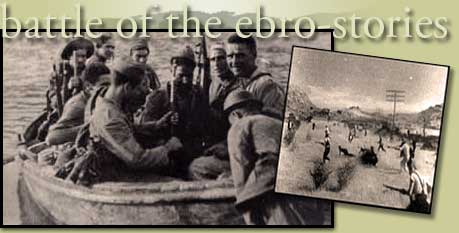
At midnight between 24th and 25th July, 1938, under the command of Lieutenant Colonel Modesto, soldiers of the newly formed Army of the Ebro, crossed the river, breaking through the defensive lines of General Yagüe’s Moroccan Army. The Battle of the Ebro (as we know it today)had begun.
The Ebro campaign was a Republican attempt to divert the Nationalist army’s attention from the Valencian front. The threat to the industrially important area of Sagunto and the city of Valencia was becoming increasingly apparent. Coupled with this, international circumstances, tensions generated within Europe by the Nazi regime’s obsession with territorial expansion made it clear that the Republican government needed to act in order to regain a more favourable position abroad.
The campaign, based on a surprise factor was planned by General Rojo of the General Staff who proposed a risky multiple river crossing. Once the first phase was accomplished, the Republican troops would have to take advantage of this initial success by covering ground quickly and moving inland from different points.
The surprise of the initial attack was a success and different units from the 42nd, 3rd, 11th and 45th Divisions of the Army of the Ebro crossed at various points from Mequinensa as far as Amposta, with the central offensive concentrating on the area between Riba-Roja and Benifallet.
The units of the 50th Division of the Moroccan Army, defending the central territory offered very little resistance and were forced to retreat to a line of defence along the Faió – Pobla de Massaluca – Vilalba dels Arcs – Gandesa – Vall del riu Canaletes axis. This line was established on 26th July and was continually attacked by the Republican Army until the 3rd August, in an attempt to break through and continue the advance.
The Nationalist forces’ reaction was very quick and within a few hours units were sent to the battle area from all parts of the country to hold the new defensive line. Their use of aircraft and the control of the upstream reservoirs made it more difficult for the Army of the Ebro to supply the frontline.
Once it was clear that it was impossible to continue advancing, on 3rd August, Lieutenant Colonel, Modesto gave the order to adopt defensive positions. The Republican Army had achieved their original aims: the pressure on the Valencian front had been relieved and the campaign had brought the military initiative back to the Republic in the war and gained the attention of the main European powers.
The Battle of the Ebro could have come to an end here. However, in spite of some of his general’s advice who believed in maintaining a stationary frontline and initiating an attack against Catalonia via Lleida, General Franco decided to recover the lost ground at any price. This decision made the Ebro campaign to become known as the cruellest and most bloody battle of the whole Spanish Civil War and indeed of Spanish history.
From this time onwards and until 16th November, the Nationalist Army took part in six offensives against the Republican lines. The territory gained by the Army of the Ebro in just one day required more than a hundred days to be recovered.
The result was a war of attrition, the downfall of the Army of the Ebro, which had fewer material and human resources. Both armies suffered around 130 000 casualties in total and lead to the fight for Catalonia, starting in December of 1938.
As well as its importance from a military and historic point of view, the Battle of the Ebro became known as the last ditch attempt of Negrín’s government during the Munich Conference from 29th to 30th September of 1938 to get the European powers to support the Spanish Republic. The rest of Europe bowed down to Hitler’s Germany during the Sudetenland crisis and effectively condemned the Spanish Republic to defeat at the hands of the Nationalist uprising.
The Ebro campaign was also the last battle in which the International Brigades fought for the Republic. On 21st September, President Negrín announced their withdrawal from action in Spain.
All these events lead the Battle of Ebro to become a fundamental reason for the understanding of contemporary Catalan and Spanish history, with a powerful link to events in the rest of the world.
Text taken from the Battle of the Ebro website. Please make sure to visit them. Click Here
 They also have recommended routes for you to follow


